

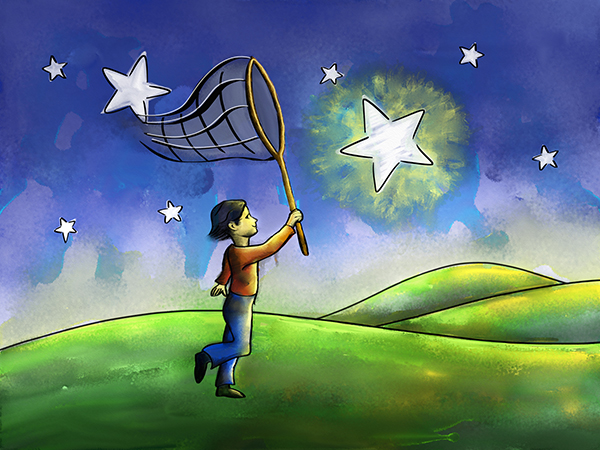
【From Software Engineer to Career Consultant】
Part 4: Dreams and Courage
During those years when I wasn’t working a corporate job, I would sometimes hear friends or former colleagues talk about their dissatisfaction, confusion, and struggles with their careers—especially those who, like me, grew up under the collectivistic culture of Asia. People like us, raised in societies that value collective rules and expectations, are used to following our parents’ and society’s viewpoints as the guiding principles of our lives since childhood. It was always very natural for me to share my personal experiences and insights with them. I could feel the happiness and sense of accomplishment knowing people receiving my advice found it helpful and did make meaningful changes and choices.
Based on my self-understanding from personality psychology, I had already become aware of my Counselor traits: good at listening, building trust, and guiding people. So, when I started offering free career counseling to others to test the waters, I became even more certain that this was what I wanted to do. It not only combined my natural strengths but also ensured that my ten-plus years of rich corporate work experience didn’t go to waste. Combining the two allowed me to offer broader perspectives and more realistic advice to others.
I am someone who always expects myself to continuously learn and grow. For the second half of my career, my focus gradually sharpened: I wanted to become a professional consultant specializing in workplace psychology, as well as an expert in people dynamics who helps others develop happier and more successful career paths. To achieve this, I felt that simply getting a few certifications wasn’t enough; I craved more solid knowledge and training. I could hear a voice inside me saying: I want to go back to school to be formally trained. I want to earn a Ph.D degree. But, at that time, I was already 40 years old. From the perspective of many practical conditions—whether it was finances, age, the responsibilities of motherhood, or physical stamina—it was actually full of challenges and immense difficulties.
I would feel embarrassed to tell others about this thought and wish, feeling certain I would be laughed at and that no one would support me. But this voice was so clear and grew so loud that I couldn’t ignore it. One day, during a gathering with my close friends from church, I summoned the courage to voice this idea, just tentatively, not expecting approval. To my surprise, they held a highly positive and encouraging attitude, supporting me in taking this step to realize my dream, with full confidence in me.
I still clearly remember how emotional I felt that day. After returning home, the surging inspiration in my heart kept my heart racing and brought tears to my eyes. I deeply realized that chasing a dream requires courage, and that the support others give to this courage holds immense power—enough to keep me burning for the next few years.
After that, I took actions — researching possible universities for my situation (had to be within commuting distance from where I lived because relocating wasn’t an option), the admission requirements, and initiating the application process.
In the same year when my son entered the first grade of elementary school, I also entered my first year as a doctoral student. I was 42 that year.
I must admit, going back to school in middle age, facing an incredibly heavy academic load in an entirely new field with massive amounts of reading and writing—for a middle-aged woman in her 40s who also had to take care of a child in elementary school—the pressure is something I don’t need to elaborate on for anyone to imagine. Yet, despite the physical overload, I actually enjoyed the process of studying and learning. Moreover, because of my unique background—years of training in science and engineering, a highly logical mind and ability to structure complicated things, and over a decade of work experience—I performed exceptionally well in every single class. The depth and breadth of my thinking were often beyond the reach of other (usually younger) students and earned me high praise from the professors.
During my years doing my Ph.D., the constant rushing and exhaustion significantly drained my physical health. I often arrived home from school in the midnight, and the first thing I would do, with an exhausted body and mind, was go to my son’s bed, gaze at his sleeping face, pray for him, and wrestle with my feelings of guilt. Then, the next day, I would keep going…
I told myself in my heart that I needed to get my doctoral degree as fast as possible, to shorten this period and enter the next, freer stage sooner. So I was speeding all the time. During the first two years of my Ph.D., I was already preparing for my dissertation, actively refining my research topic and gathering any relevant sources of information. When taking the qualifying exams, I was the only person in my cohort to pass all subjects unconditionally on the first try with all professors’ unanimous approval, requiring no reviews or revisions. Although English is not my native language and it was my first time focus on studying the humanities and social sciences, all my academic writing received high evaluations from the professors, to the point where they even asked me to guide other students demonstrating my approach of thinking and writing. In my third year, I immediately launched my research (on the relationship between personality traits and workplace environments), and a year later, I completed my doctoral research and dissertation.
When I was about to apply for my defense and early graduation, my advisor said with a look of disbelief, “No one in our school has ever completed the program and graduated this fast (in three and a half years). You are the first one to break the record.”
I am the kind of person who would go all out once the meaning is found and a decision is made. Also self-discipline that I learned and inherited from my father plays a big part in terms of time management and goal achieving.
I don’t believe that everyone has to choose the same path as I did, because everyone is different. You might encounter situations different from mine, be a different type of person, and have different personality traits and strengths, so replicating someone else’s path is meaningless.
But there is one conclusion that is universal. Having walked this path myself—which may look glamorous on the outside but in reality involved countless rugged twists and turns, as well as the strength required to repeatedly overcome difficulties and pressure— I can tell you this:
“People are made great not because of their dreams, but because of their courage and action taken to pursue those dreams.”
<the end>

1 Comment
Anne
看到這系列的文章以後,發現我並不孤獨,我目前也是軟體工程師,我也是 INFJ,在技術上我也漸漸失去了熱情,覺得自己很迷惘,但目前還沒有找到方向。從小認定當個軟體工程師就是我所喜愛、所追求的目標,不過在這幾年常常有種不知道為什麼而開發的想法,總是不是在解決真實問題的過程裡面打轉或是圍繞在技術、架構的泥淖裡面居多,也是為什麼讓我思考軟體工程師真的適合我嗎?